
Zip, Zero, Nada

Zip, Zero, Nada

Does salary level determine a job’s worth, or a person’s?

Most of us would say “no way,” including myself, yet actions and behaviour speak louder than words.

When I was earning a decent salary, some might have called it indecent for my age; people treated me differently. They seemed to respect me automatically, and I never felt I had to justify my actions. I was making a lot of money, so my work was worthy, and by default, so was I.

Then I became a stay-at-home mom, and we all know how much stay-at-home parents get paid. That amount is zip, zero, nada.

Nobody questioned my decision when I first decided to become a stay-at-home parent. I had some savings from work and was expecting my second child. I had worked enough to be guaranteed parental leave benefits when my second child was born.

Now that I think about it, it’s fascinating how many people had opinions on my new status.

Most people told me I was making a good decision. They said, “Your children are only young once; you’re lucky to spend time with them when they’re young.”

And I agree. I was fortunate to spend time with my kids when they were young.

But the other message I internalized from this comment was that I wasn’t genuinely working, or that I was working at a job that benefited anyone other than me.

As time went by and my kids got older, four and two, my justification for staying home became more and more of a topic of conversation, and I became more internally defensive. I started keeping a mental list of how I was contributing to our household, one I began obsessing over almost daily.

The first question out of my spouse’s mouth when he got home from work was, “What did you do today?” He probably wasn’t looking for proof I’d worked, but I had my list ready anyway, just in case, to show I hadn’t spent the day surfing the web. My husband never had to justify his actions. He brought home a paycheque every two weeks that did it for him.

To feel more justified in what I was doing, I decided I could live with less “fun” money than my husband. I cut my leisure spending to one-third of his.

It’s telling what that pay cut did to our family dynamic. I didn’t need the extra money, but in a sense I’d taken a notional pay cut, which further minimized my sense of worth. My relationship with my spouse became more unbalanced. We were no longer equal, not in my eyes, and not in his.

At that point, my husband and I had monetary proof that my job wasn’t as worthy as his.

This concept carried into our divorce process. We barely discussed how I’d contributed to the household. My contribution was glossed over, and the main conversation revolved around when I would start “work.” We didn’t discuss the fact that I had effectively lost my job, because being a stay-at-home parent is not recognized as a job. I’d been on a lark, apparently, and now I had to get down to business and find something worthy.

What was the difference between my job and my now-ex’s? His was paid. Mine wasn’t.

If you’re considering becoming a stay-at-home parent, I’d encourage you to set up your finances like this:

Take your spouse’s salary, divide it by two, and automatically transfer half into your own bank account every pay period. Then you and your spouse each pay half of the joint family expenses, and cover your personal spending from what’s left over.

If you’re about to become a stay-at-home parent, talk through a financial arrangement like this with your spouse before the baby is born. If your spouse doesn’t support a proposal like this, that’s worth talking through further before you give up a career for a job with no paycheque attached.

If your spouse does support it, you’ll know they consider the work a worthy endeavour, worthy enough that they’re willing to pay for it. Because, despite the saying, money does define the worthiness of jobs and people, at least in how we treat each other. Actions and behaviour speak louder than words.

The Checklist doesn’t solve it

The Checklist Doesn’t Solve It

My blog post ideas usually hit me on the head when I’m struggling. Today’s struggle was getting my kids out the door to school.

This seems straightforward in theory. I even made a checklist, taped to the fridge:

Wake up, 7:30 am. Get dressed. Eat breakfast. Dishes in the dishwasher. Brush hair. Brush teeth. Lunch in your bag. Water bottle in your bag. Coat on. Shoes on, 8:30 am.

Twenty minutes, easy. I got up at 6 am today. By 8:30, we were nowhere close to ready, and I found myself wondering if my neighbours were about to call the police over what sounded like a domestic disturbance in my kitchen.

Nothing was wrong with the list. My kids are good at following lists. Something else was missing.

It reminded me of my work with clients, which starts the same way: a template. A spending plan, property, debts, all filled in over what should be a couple of hours. Both the checklist and the template look concrete and achievable on paper. Both take longer than they should, and both come with more angst than the task itself would suggest.

Because the real work was never the checklist or the template. The real work with my kids was figuring out what was actually going on underneath, the reason two siblings kept finding new and creative ways to torment each other. That meant talking to their dad, coordinating with grandparents whose old discipline methods weren’t landing the same way with these kids, and doing the relational work instead of hoping a fridge list would fix it. That work is slow and uncomfortable, and it’s the part I tend to avoid.

The spending plan template works the same way. Filling it in takes two or three hours, tops. That part really is easy. But the ease is only on the surface, the same way the checklist looked easy until it didn’t hold.

When I did this work with clients, I’d ask what was actually going on underneath, whatever was likely to stretch a simple two-hour process into something much longer, and I’d encourage them to deal with that first. Not because the spreadsheet mattered less, but because reviewing a spending plan is quick. It’s only worth doing once the angst underneath it has somewhere to go.

I used to tell clients: this will take three hours if I’m working in a total vacuum the moment I get your information. But nobody works in a vacuum. It could take three hours, or a while longer. We’d figure it out as we went, and I’d keep them posted as best I could.

Custody of Kitty

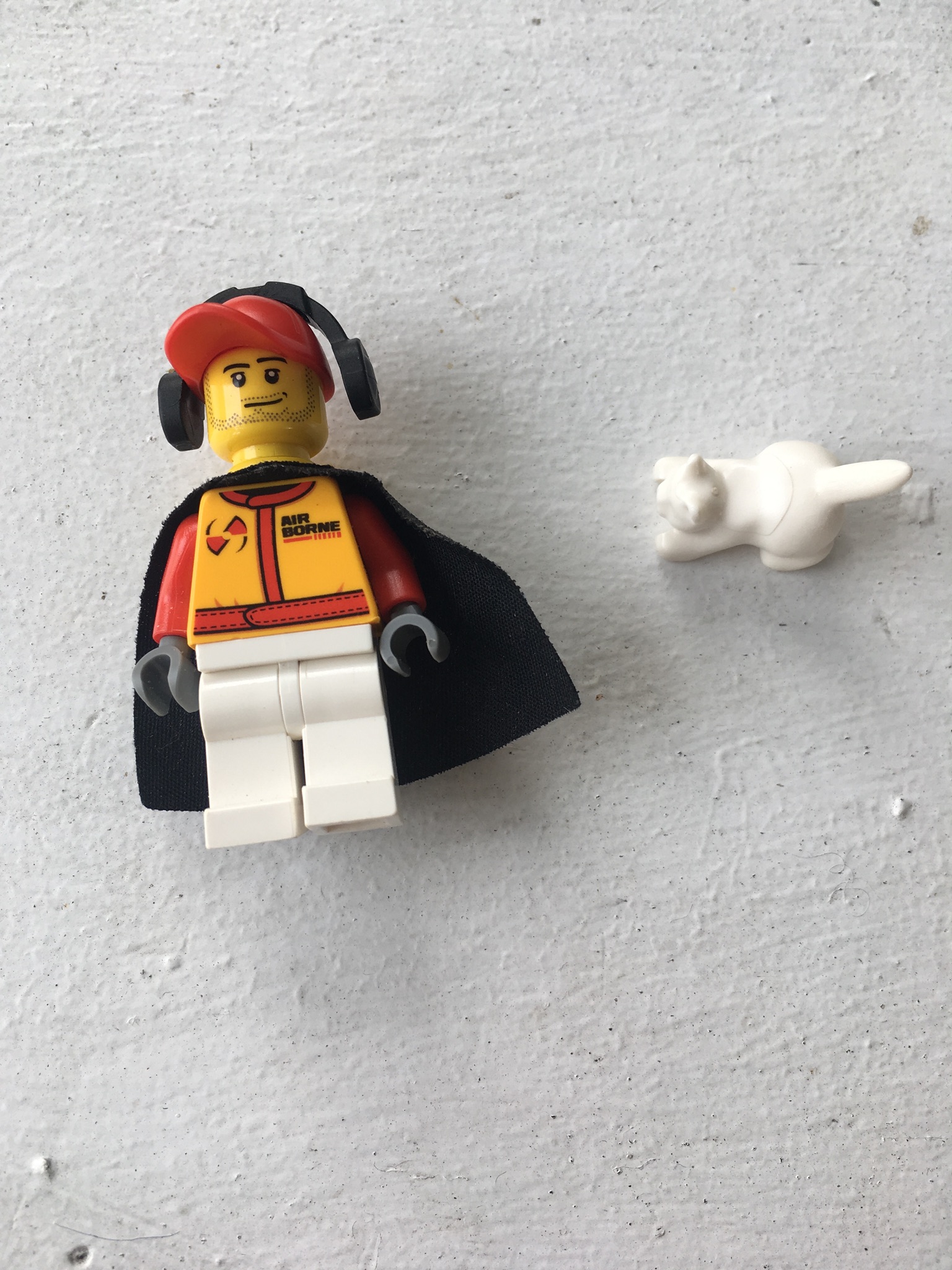
This is Kitty And this is Kitty out enjoying nature. 

Looks like a fireman Lego with a Darth Vader cape and falling-off headphones, you might think. Oh, how wrong you’d be.

Kitty, the combination of Lego man and Lego cat, the unit is called Kitty, caused a lot of conflict in our household last week.

I was dutifully cleaning up the dishes when I started to hear screaming coming from the area my kids had disappeared to. They always make themselves scarce when there’s work to be done. Someday soon they’ll be trained on dinner dishes.

I went to investigate, and as I got closer, the screaming became clearer.

“You’re an idiot!”

“No, you are!”

“Get out of my room, you’re always taking my stuff.”

“Kitty’s mine! Give it back!”

As I rounded the corner, my youngest hurtled by, clutching something in his hand. I reached out to grab him.

“What’s going on?”

I got a stereo synopsis of the situation. The kids were fighting over Kitty.

I yelled, ” Stop, ” and asked them to hold onto Kitty while we figured things out. The yelling continued, so I yelled stop again.

I called a time-out. “Okay, we all need to calm down, and then in ten minutes we can discuss what’s going on here, but we all need to get to a point where we can talk and not yell. I can’t help you two figure out anything while you’re yelling.”

So my kids went to their respective corners, not easily done. When my eldest is ramped up emotionally, he needs ten minutes alone in his room. Really, he needs twenty-four hours, but we’re working on ten minutes so he doesn’t lose an entire day. My youngest gets thirty seconds of screaming his head off, stomping, slamming doors. Thirty seconds. It’s fun, but it’s what we have to work with. It used to be three minutes. We’re whittling it down.

The kids had their time-outs, and I used the time to strategize and breathe before becoming mom-mediator. Not enough time.

We started to discuss what to do. Both kids wanted Kitty. Both were convinced Kitty was theirs. So first we explored that.

“How do we prove who Kitty belongs to?” I asked.

They started arguing over which set Kitty must have come from. A fireman set? Seemed reasonable. Then they argued over which kid had gotten the fireman set. They tried to get me to cast the deciding vote, but honestly, I couldn’t remember. I tried the analytical approach: you, oldest child, never liked firetrucks, you liked SpongeBob, so in theory Kitty is more likely from a set belonging to the youngest. This led to a lot of protesting from the older one, who explained that various pieces had come from multiple sets he’d creatively combined.

Still stuck. They dragged out every Lego manual to trace where each piece had come from. We did this for a while, until my oldest remembered he’d taken most of the manuals to his dad’s.

All the while, I was trying to help them think past “this is mine and therefore not yours.” Could we find equivalent pieces to build a second Kitty? Apparently not, there was only one cat. Could they take turns? Clearly not.

So I tried getting each of them to see the other’s point of view. I asked my oldest to explain what Kitty meant to him. He walked through the whole inspiration behind Kitty’s creation, how he’d picked each piece and why they belonged together as one unit. I’ve since forgotten the details, but at the time I could tell he felt real pride in what he’d built.

As he explained, my youngest rolled his eyes and huffed. I asked him to stop and listen, he’d get his turn too.

He did. And he repeated almost exactly what his brother had said, for nearly identical reasons. He loves his older brother and wants to be just like him.

I believe my oldest actually created Kitty. I also have a very non-self-aware youngest who genuinely believes he did.

After hearing what Kitty meant to each of them, I wanted them both to get to play with him. But they were still dug into their positions. I’d hoped that hearing each other out might lead somewhere, a duplicate Kitty, a sharing arrangement, even one of them stepping back and saying Kitty clearly meant more to the other. No such luck. They were stuck, and so was I.

I had to pull out the judge card.

“Well, it looks like we need a custody arrangement for Kitty. I’ll hold onto him overnight while I think about who gets the first play shift.”

I’ve had Kitty ever since. He’s been living in my car, riding around with me. I’ve become quite attached.

The BAD MOTHER tagline

I wrote the post below back when I was recently separated with two young children, in the thick of grief and anger, most of it aimed at my ex. I felt like I had no control over my own life. photo-1470319149473-af271634cecf

The Bad Mother Tagline

Have you ever thought of yourself as a bad mother? I know I have. “I’m a bad mother” has been the tagline running under nearly every parenting mistake I’ve made since my oldest was born, ten years ago now. Forgot his hat. Bad mother. Yelled at him for being irritating. Bad mother. Forgot to remind him to look both ways when crossing the street. BAD MOTHER. A friend and I once joked about getting matching T-shirts that said “dumb mum.”

We’re wired this way as a species, apparently, quick to forgive everyone except ourselves.

I got a fresh reminder of this a few weekends ago.

My kids’ dad asked if I could take them for the weekend. He asked on Wednesday. I was buried in work and had promised myself I wasn’t working weekends anymore. My answer should have been an easy no. I had plans. I needed the recharge.

No was right there, on the tip of my fingers as I started typing my reply. Then something stopped me.

The thought: I’m a bad mother.

How could I not want to be with my own kids? Their dad needed help. How could I put my own interests ahead of theirs?

So instead of no, I said yes. I cancelled my plans and told myself that wanting that time in the first place had been selfish.

You can probably guess how the weekend went. Not well.

It started going sideways Friday at 2:30, when my youngest called from school with a tummy ache. I knew immediately it wasn’t real, not medically. He hates last-minute changes, and switching up the schedule on short notice was enough to give him an emotional stomachache. The apple doesn’t fall far from the tree. He needed time to process the change. So did I.

I’d been counting on those hours to get my work done before pickup. Instead, I found myself standing in front of my seven-year-old, and the first words out of my mouth were: “Do you really have a tummy ache?”

I heard myself say it, and right behind it came the tagline, on schedule: I am a bad mother.

I spent the rest of the weekend taking my mood out on my kids in small ways I’m not proud of, and by the time they left, I was cycling through the whole tagline lineup. Bad. Hadn’t learned a thing. Still the same people-pleaser I thought I’d outgrown.

Monday morning, kids gone, I finally had space to think. I cried, partly from the weekend itself, partly because I still had work waiting and no energy left for it.

Then I started writing, and something clicked. I’d just gotten the clearest proof I was ever going to need that the “bad mother” tagline had to go. For good.

Looking back at that weekend now, oddly, I’m grateful for it. Thank you, terrible weekend. You were the thing that finally put that tagline in the ground, along with the others I’d been using to beat myself up for years.

How do You Know When to Pull the Plug on Your Marriage?

photo-1473773386757-42bbe7288351

The Two Fears That Almost Kept Me Married

When do you decide to give up on a marriage, actually call it quits, and ask for a divorce?

I ask because I honestly don’t know the answer. I never made that decision myself; my ex made it for both of us. Left to my own devices, I probably would have stayed until death do us part. I have a high tolerance for pain, and I’ve always preferred trying to fix things over walking away from them. I still want an answer, even though I’m slowly learning there isn’t a clean one, which is basically why I’m writing this at all. When do you actually call it quits?

Put another way: what’s actually stopping you from initiating a divorce, if part of you wants to?

From what I’ve seen, mostly fear. Two fears in particular tend to do the heaviest lifting: money and the kids.

Let’s take them head-on.

Fear One: You’ll Be Much Worse Off Financially

Being poor was one of my fears too. Combined, my husband and I could live comfortably in an expensive city on one income. Divorced, that math falls apart. I’d need a job, we’d need childcare, we’d need to split assets and fund two households instead of one. Both our standards of living would drop. That was a genuinely depressing thought, enough on its own to keep divorce off the table. I’d rather be unhappy and financially stable than happy and broke, or so I believed at the time.

My divorce happened anyway, and yes, my net worth dropped. My cash flow took a real hit. That brought real anxiety with it. I used to build monthly budgets just to confirm, yet again, that there wasn’t enough coming in to cover what was going out, which only fed the anxiety further, until I finally made the connection that stressing myself into a spiral wasn’t actually accomplishing anything.

Eventually I realized I’d always managed, one way or another. I cut my spending, found ways to bring in more money, made decisions, and kept moving forward in a direction that matched what I wanted for my life. For some people that means earning more. For others, it means spending less. Either way, there’s usually a path through.

Three years out, I can say plainly: being happier on my own is worth far more than what the divorce cost me financially.

Fear Two: The Kids Will Suffer

I’d been the primary caregiver for our two kids, four and six at the time we separated. I genuinely couldn’t picture their dad managing them alone for half their lives. Surely they’d go unfed, unbathed, put to bed late, and laundry would pile up forever. And beyond the logistics: my kids wouldn’t be with me for half their lives. They were four and six. They needed their mother. I needed them. They were, in a lot of ways, my whole purpose.

To be clear, my kids wanted us to stay together. My youngest once cooked up a plan where I’d rent an apartment in the same building as his dad, so we could live down the hall from each other. Adjusting to only having one parent around at a time was hard on them at first. But they adjusted. Honestly, it wasn’t even that different from before; my ex and I had barely occupied the same room together for the two years leading up to our separation anyway. They still have to manage two different sets of house rules, switching gears twice a week, but that’s just life. We all have to manage shifting expectations across different parts of our lives, jobs, family, everything. Kids of divorce just get more practice at it earlier than most.

It was harder on us, the parents, I think. I missed my kids desperately for a full three years after the divorce; I have the blog posts to prove it. It took my mom asking me this past summer, while the kids were away for their two-week stretch with their dad, “Do you miss your kids?” for me to actually notice something had shifted. I said, “No, I don’t miss them,” and then really sat with what I’d just said. The old version of me would have felt like a traitor for saying that out loud, wondering what kind of mother doesn’t miss her kids. Instead, I recognized it for what it actually was: a real milestone, for me, for their dad, and for them.

It took three years to build a life that could actually make me happy while my kids were away, and three years to genuinely trust they’d be fine with their dad. What I’ve come to believe, in that time, is that kids do better with two parents who are both actually capable of caring for them. Yes, it takes more coordination, and the back-and-forth between households is tiring, sometimes a little painful. But now they have two parents who can feed them, get them to school, sign them up for activities, and arrange their own plans. Two parents genuinely involved in their lives. I probably still do more, if I’m honest, but their dad is doing far more than he ever did while we were together. If we’d stayed married, I’d likely still be doing everything, and he’d likely still be on the sidelines. Now I have my own life, and a life as a mom, both. Time for my own things, my own work, my own growth, alongside real trust that my kids are being cared for by someone who loves them. That’s a genuinely good outcome.

It took three years to get here, though. Three years to understand that their dad does love them, and that doing things differently than I would isn’t the same as doing them worse. It’s just different. How do you even judge what good parenting looks like? The best I’ve landed on: a good parent is someone who loves their kids and is genuinely trying to do right by them.

Three years out, the fears that kept me in my marriage turned out to be mostly unfounded. I’m grateful my ex worked through his own version of those same fears and finally ended things. The marriage had run its course. We were done. We’re better for being divorced.

The Part-Time Single Parent

photo-1449177009399-be6867ef0505

The Part-Time Single Parent

When my first son was in his first year, I remember being so relieved I wasn’t a single parent. I was in awe of anyone who was.

Years later, I’m a single parent to two spirited boys for half of my life. The other half, I’m supposedly footloose and fancy free, though really it’s just catching up on the work I didn’t get to while the kids were with me.

So I don’t really think of myself as a true single parent, except on the days I am. Fortunately, I don’t have much time to sit with that thought, though it creeps in sometimes: single parenting really sucks.

On those days, I wake up at my usual 5:30, my body simply won’t stay asleep, and I sneak to my work nook to get ahead while I can. If I’m quiet enough, my morning child won’t hear me. He has some kind of instant mommy sense and knows the second I’m up, then follows me down asking if he can watch TV. If I dodge him, I work. If I don’t, I’m entertaining him until his brother, the late sleeper, wakes up. I make breakfast, make lunch, get them out the door for school, come home, work, work, work, pick them up, make dinner, clean up the mounds of stuff they haul home, get them to bed, try to squeeze in a little more work, and pass out, only to do it all again the next day. That was a run-on sentence, and it mirrors pretty well what those days actually feel like.

Every so often my kids’ dad travels for work, and I have them for two weeks or more straight. Those stretches are when I really feel how hard single parenting is, and I’m always grateful knowing a break is coming once he’s back.

Having a co-parent isn’t automatically easier, though. We couldn’t live together for good reasons, and parenting together across two households is still genuinely hard. On the days we disagree the most, part of me wishes I were just the one in charge, no negotiating, no dealing with someone I find unreasonable in that moment.

Then I get the kids back, and I have to figure out how to work with him again anyway.

All of this has led me to a few fairly firm conclusions.

Single parents need a lot of support. A lot. I’ve spent the past few years actively building that for myself: breaks I can count on, even if they’re not frequent, other people in similar situations to talk to, and a real backup plan if I ever hit a wall, which for me is my co-parent. Society’s slowly getting better at recognizing how hard this is, and support exists if you look for it. I also built plenty of my own, partly because the people around me kept nudging me to.

The other thought that keeps circling in my head: we talk a lot about single moms, and not nearly as much about single dads. They’re out there too, and they need support just as much. I did a quick search once for single-dad support groups and found almost nothing nearby; the closest one I could find was clear across the country. I wonder if that’s part of why dads seem to move into new relationships faster than moms sometimes do, needing another parent-figure in the mix because the structural support just isn’t there for them the way it increasingly is for moms.

My last thought is simpler: relying on my co-parent only works if we can actually get along. I’m not going to ask for help from someone I’m not speaking to.

I went through real anger at him, especially right after we separated. I held back from going for blood during the divorce and chose the Collaborative Approach instead, both of us agreeing to stay out of court, because I understood that conflict between parents is what actually hurts kids the most. I picked the path with the least conflict and talked him into it too. Only now do I see how much that choice has benefited both of us as parents. We can talk. We’ve built real systems for getting along. If we’d gone for the jugular instead and dragged each other through court, one of my biggest support systems right now simply wouldn’t exist. And the kids would’ve paid for that, along with two burnt-out parents.

If you’re heading into life as a single parent, know that it’s hard. Build whatever systems you can to support and sustain yourself.

;