by Renee leNobel | Apr 4, 2015 | Divorce
In Lynne Twist’s book, The Soul Of Money, she writes:
For me, and for many of us, our first waking thought of the day is “I didn’t get enough sleep.” The next one is “I don’t have enough time.” Whether true or not, that thought of not enough occurs to us automatically before we even think to question or examine it.
When I first read the above quote I wanted to know how Lynne Twist knew exactly what was going on in my head everyday when I woke up. My waking up thoughts also ran along the lines of “I can’t do it,” “I don’t want to do it,” and “what’s the point of getting out of bed anyway?”
These were just thoughts and while they never actually stopped me from getting out of bed (my needy kids made sure I would get up), I’ve come to realize that at one point I truly believed these thoughts. It is no wonder that every day felt like a battle and my enthusiasm for life was gone.
Once I became aware of these negative waking thoughts, I started to keep a mental catalog of how often I had them. I started to notice them. I have to say that noticing how often my thoughts were negative was fairly depressing in itself. This led to further negative thoughts along the lines of “I must just be a negative, unmotivated person.”
I did this for a long time. I attached myself to my thoughts and used them to judge myself.
And then one day I stopped.
Because while I was noticing my negative thoughts, I was also noticing how much harder my days were. I was noticing that if I chose to do something else, and it could be anything that would stop me from buying into and believing my negative thoughts, my overall day wasn’t as hard to get through. This became a bit of a balancing act. I did not want to become too busy and lose all time for self-reflection, yet at the same time I had to learn to distance myself and not buy into my negative thoughts or I’d end up exhausted at the end of the day.
I’m not exactly sure when I stopped: a month, two months from the day I first started tracking my negative thoughts? All I know is that I did stop because now when I wake up I acknowledge those thoughts are still there and then I laugh at myself, get out of bed and get on with living the day I want to live.
When you’re in the midst of starting over and trying to change your life, it is important to recognise that the thoughts going through your head do not define you. For me, it took time and noticing to move me past getting drained and sucked into my negative thinking. Eventually something clicked.
If negative thoughts are getting you down, start noticing them and questioning them. Don’t judge yourself when you do get sunk by them and give yourself time to build a boundary between your thoughts and what defines you as you. This is just one step in helping you create and maintain the change you want in your life.
by Renee leNobel | Mar 17, 2015 | Divorce
Congratulations. Finalizing a separation agreement is a major achievement and usually comes at the end of a very stressful and emotional period in your life.
Signing a separation agreement will likely have a strong emotional impact on you. It is tangible evidence that your old life, the one you once had hopes and dreams for, is finally done. Signing your agreement can leave you feeling aimless as suddenly, the agreement, which has been your entire focus for your life in recent memory, is complete. But the separation agreement is not the end. It is the beginning of your new life post divorce.
The first thing you now need to do is stop.
You have been running hard and still have momentum from your old life driving you forward. You are on automatic pilot and are just trying to get through the days of your new reality.
But this is your new life and you get to design it the way you want.
One of the first things to do is give yourself some time to process the fact that you just signed your separation agreement. The day I signed, my lawyer said to me “Don’t underestimate the emotional impact that signing this agreement will have on you.” And even though she said this to me, I was still unprepared. I had big expectations that my life was suddenly going to be fine now that I no longer had to deal with my ex-spouse. Instead, feelings of sadness and failure took over. My current understanding that only one part of my life has failed, my relationship with my ex-spouse, came to me after allowing myself time to grieve. Giving myself time enabled me to more forward.
Time also helped me understand that I could design my life the way I wanted to. I did not have to try to cobble together the pieces of my old life as the only way forward. I had to take time to figure out what was important to me. For many newly separated people, this is a dramatic shift. Up until separation, you were leading a life based on shared values or even leading a life based on a spouse’s values. It is important to take the time to reassess what is important in your new life if you want to successfully move forward.

by Renee leNobel | Feb 25, 2015 | Tools & Tips
I just finished my first tax return for a family that is eligible for the Family Tax Cut that was announced in October 2014 and affects the 2014 tax year.
What is the Family Tax Cut?
The Cut only applies in certain situations:
- You and your eligible spouse or common-law partner lived in Canada at December 31 of the applicable tax year.
- You have a child that was under 18 at the end of the tax year who normally lives with you and your spouse or partner.
- You and your partner both file a tax return for the year.
- Neither you nor your eligible spouse or common-law partner elected to split eligible pension income for the tax year.
The Family Tax Cut was brought in to equalize taxes paid by families in Canada who have minor children.
The Conservative Government wishes to encourage families that have small children to have one parent stay at home and be caregiver of those children. In this situation there is generally one high income earning spouse and one low income earning spouse.
Because personal income tax rates increase with the level of income of the individual, a family with one high income earning spouse will pay more than a family comprised of two taxpayers who earn equal amounts of income.
The Family Tax Cut is essentially a non-refundable tax credit of up to $2,000 that can be claimed by one taxpayer. It cannot be shared between the taxpaying couple.
If you share parenting of your minor child with a former spouse, you can only take advantage of the Family Tax Cut if you have re-married or are in a new common-law relationship. In this case both you and your former spouse may apply for the Family Tax Cut if your child ordinarily lives with both you and your former spouse throughout the tax year.
There are other rules on eligibility so check with your tax preparer to determine if you are eligible.
by Renee leNobel | Feb 17, 2015 | Tools & Tips
If you have a child that was born in 2007 or later, you may be eligible for the BCTES grant. Click here for more information.
by Renee leNobel | Nov 24, 2014 | Divorce
If you are depressed you are living in the past. If you are anxious you are living in the future.
If you are at peace you are living in the present.
-Lao Tzu
I’ve always avoided borrowing things in my life (ok, except my neighbour’s tools after my ex got ours in the split) but thanks to my aunt who gave me this idiom today I realised that I borrow trouble. I borrow trouble with my negative future focus.
When I start thinking about the future I get fearful and start imagining the worst will happen, even though experience tells me that the worst never does happen. My default future focus seems to be worst case scenario. I’m still debating with myself if my fear outlook came preset at birth or if I learned it.
I grew up in the 80s and at that time the concern was nuclear weapons. Movies like Mad Max, The Terminator and Threads cast a shadow over the future for me at that time. Books I was reading in school were the likes of the Chrysalids, Brave New World and 1984. As the threat of a nuclear holocaust faded (about the time I graduated in 1989 when the Berlin Wall came down), other threats rose to take their place such as the war in the Middle East and Climate Change. All my life I have taken these fears on as my own and combined them with with personal fears such as tragic death, poverty and and unhappiness.
I lived in a fearful imagined future and the worst part about it? I would change my present to avoid that future. I would alter things dramatically in the present so that imagined future would become less clear. Or I would rip the bandaid off. Ever do that? I would force the bad into the present just to get used to it. It’s no wonder I was unhappy. I was spending my present moments trying to dodge an imagined future or getting myself used to it.
Then I became aware of what I was doing. The trigger to my self awareness was my divorce and the spiral downward that accompanied it. I could not fathom how I had become so unhappy. I started to realise my thoughts were the culprit. I got a lot of help with this – from Byron Katie and my life coach.
My life coach would point out when I was thinking about the future and I started noting how miserable my future focus made me.
That was the first step. Noticing. The second step has been to come up with positive futures. This is hard. My thoughts still go to bad and I can get trapped there for a while. Today I spent a good four hours in bad future when my ex started arguing about how we would share the kids at Christmas. I immediately went to rip the bandaid off and pictured myself all alone for the entire two weeks of the Christmas break. And then I started to remember what I’m learning. I started practicing a different picture of Christmas. A good one, where I would get the kids in the morning (when they are still filled with excitement) and he would get them at dinner (when I’m usually exhausted by it all). This is what he wants. It would work.
I’ve come to this realisation after a day spent borrowing trouble. I’ll cotton on quicker in the future.
by Renee leNobel | Nov 10, 2014 | Divorce
There are many of negative thoughts out there that keep a person stuck in one place. I know because these thoughts kept me stuck: I let those thoughts control my actions.
One thought that keeps turning up in my life is “I can’t do it.” This is accompanied with “I am not good, smart, ambitious, deserving. (insert any positive adjective here) enough.”
I don’t know when I internalised this thought and then started living my life according to it, but I didn’t discover that this thought was in the driver’s seat of my life until my divorce. Since then I have been aware of this thought and working at ways to not let it rule me. I know it is working because now instead of it being me saying “oh no, I couldn’t do that.” I have people saying to me – “wow, you have accomplished so much…. I could never do that, I not smart, driven (insert positive adjective here) like you.”
I had four people say this to me last week in one form or another and it was quite surprising. How had I gone from being the person saying “I can’t do it.” to the person that is saying to others “you can do it”?
The first step for me was recognising that most of my inner dialogue throughout my life had been defeatist, often verging on self-loathing. I started journaling (I can hear the protests now: “I can’t journal” from some of you reading this. I always thought I couldn’t journal either. I told myself that and guess what? That was pretty self-fulfilling).
Ok, so I started journaling and documenting my inner thoughts. They were pretty negative and then I got self-loathing about that! For about two weeks I was saying to myself, “I can’t do it and how can I ever be expected to do it because I was born self-loathing.” Actually, that might have been more than two weeks.. That was a bit of a vicious whirlpool I was in for a while.
So then I read something else. Those thoughts that I was having? They weren’t mine. Nope. They were put there by society (darn you society).
At that point, it started becoming slightly funny and almost game-like. When my mood started to go down, I would try to identify the thought that was taking me there. And there was always something. Those thoughts are sneaky and can sometimes catch you unawares and send you spiralling down before you notice. That is the game for me, catching them before they do that.
That is essentially all I had to do. It took me a long time to figure it out but I finally did. What is amazing is that it completely ties into the idea that you manifest your thoughts. For a good chunk of my life I manifested “I can’t do it.” and now I am manifesting “I can do it.” It was simply a matter of recognition and belief.
Do you believe and listen to the thought that you can’t do it? Do you often say to others who you perceive to be more successful “but you are smart, driven, lucky etc.” and use that as an excuse as to why you can’t do it? I want to challenge you to recognise this thought for what it is. It is just a thought that is only true because you have made it so. You have manifested that thought in your life.
You can change. I know you can because I have first-hand experience. I have overcome a 40 year deeply entrenched personal mantra of “I can’t do it” within the space of a year.
But only you can do this… and I know you can.
by Renee leNobel | Nov 7, 2014 | Divorce
Do you sometimes think to yourself “I am alone”?
I do. It is usually immediately after dropping my kids off at school on a day that is the start of a five day stretch where they live at their dad’s home.
It doesn’t matter that about thirty minutes earlier they were driving me bonkers with their loudness and fighting and I couldn’t wait to get them out of the house.
As soon as I give them a hug and a kiss goodbye and reluctantly walk away from their school, the thoughts take over.
Here is but a sampling:
“I do not get to see my kids for five days…. actually six if I include Wednesday when they are at school!”
“It is not natural that a mom does not get to see her kids.”
“I can do it, I know this is just a thought.”
“I am sad, it ok that I am sad, it is a sad situation.”
“I have things planned for my time. I was relishing have free time two days ago, remember that feeling.”
“I am alone.”
It is that last thought that really gets me. I don’t know if there is a more unmotivating and devastating thought out there. That thought takes me out of living the day as I want to: with hope, joy and purpose.
So I am writing about this in the hopes of recognising what that thought does to me if I take it on. Awareness if the first step as the saying goes.
by Renee leNobel | Nov 6, 2014 | Tools & Tips
If you live in British Columbia then you likely have an account with BC Hydro. In fact, getting an account at BC Hydro was one of the first things I did when I moved out and became an independent person. At that time, I was told a good way to build credit was to make sure I always paid my BC Hydro account on time. Almost 20 years later, I realise what good advice this was.
You might think that there are no ways to save with BC Hydro, but I am all about potential ways to make and save money.
The first step is to create a My Hydro profile
The second step is to go on the equal payment plan if you haven’t already done so. This plan ensures you pay the same amount every month. Don’t worry, you don’t have to figure it out, they do. At the end of the year, if you paid too much or too little they do an adjustment. If you want to take it further, you can sign up for pre-authorized payments from your bank account. You know what the amount is going to be and paying your Hydro bill becomes one less thing you have to do every month.
Going on the equal payment plan helps with your monthly spending plan. Now you know exactly how much is coming up for BC Hydro which means you can figure out how much money you have left to spend on other things in your plan. Ok, I had to sneak some spending plan info in there.
The next step is signing up for Team Power Smart
Joining Team Power Smart does not require any work, other than the initial sign up but there are big benefits.
If you manage to decrease your consumption by 10% year over year then BC Hydro takes $50 off your bill. Not to mention the fact that you just saved 10% of your bill. Assuming you spend $75/month on Hydro, you will also save about $90 over the year. Every year after in which you maintain your lowered consumption, BC Hydro will give you back $25.
By signing up for Power Smart I became more conscious of my Hydro bill and I have figured out what costs me the most; it’s my dryer. I now hang my clothes out as much as possible. This can be hard to do in Vancouver, but you might find another way. Perhaps you like to fall asleep to the TV every night? Why not get up out off the couch and go to your bed. You’ll sleep better and it could save you money.
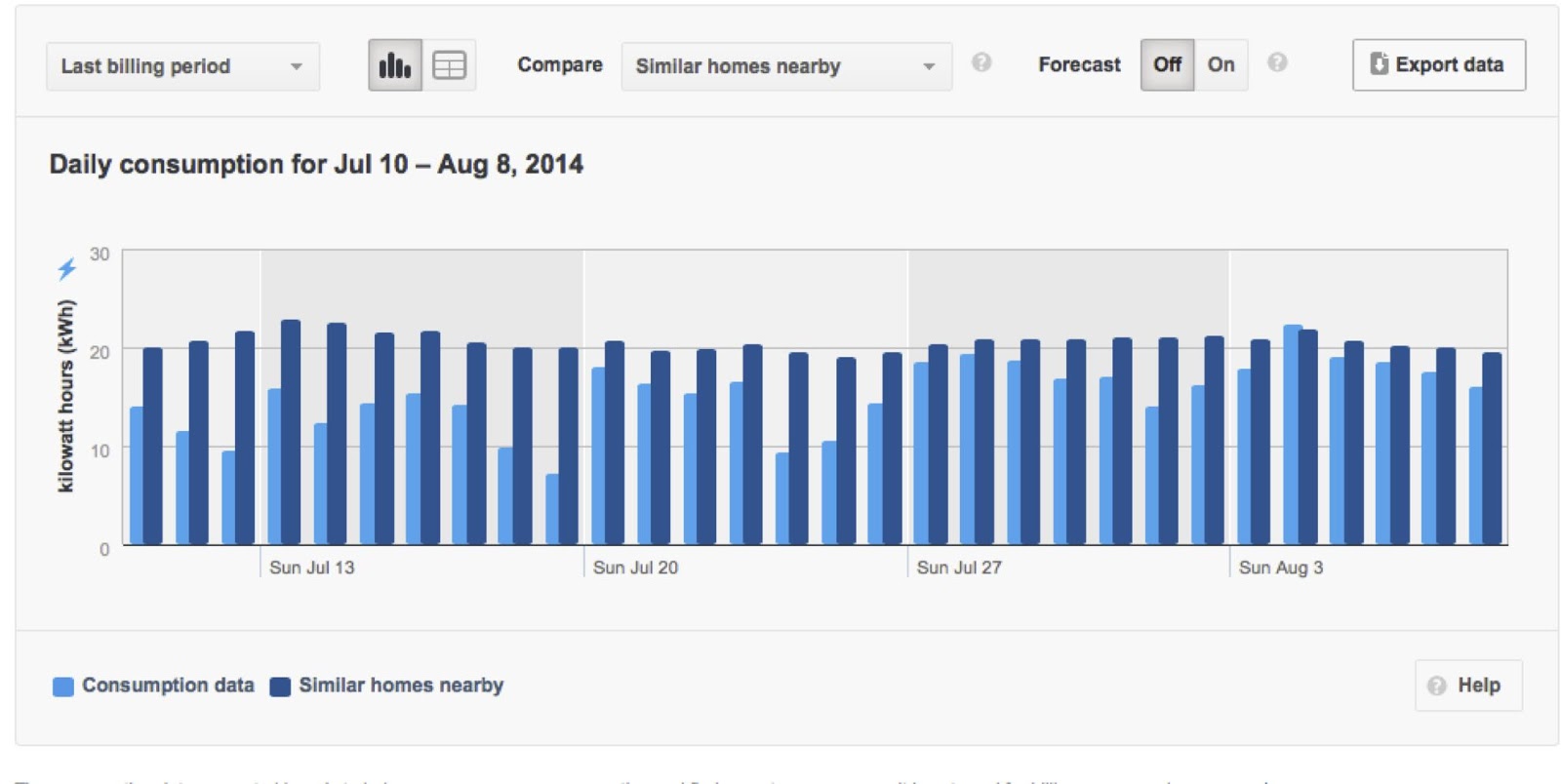
It becomes a bit of game to figure out where you can save on your bill. I especially like the graphs on their website – Here’s one that compares my household consumption to my neighbours!
Taking this step does not take a lot of time. Once you are signed up, it is up to you how often you want to check how you are doing. I find I look once a month when I get my bill notification. The other great part about this is that it helps the environment. Yay!
by Renee leNobel | Nov 6, 2014 | Finances
You are not alone and not surprisingly this is one of the leading causes of breakups and divorce. Many partnerships are comprised of these two opposing personalities which makes sense as opposites attract and when they get together each gets to see how the other half lives. Living with a spender can be fantastic fun for the normally conservative saver. At the same time, the spender might like the practicality and planning ability of the saver and will feel taken care of and supported.

Saver and Spender are as opposite on the financial personality spectrum as it gets. Saver thinks about the cost and the future before deciding to do anything and Spender is all about living in the now and seizing the day. This couple can make a powerful twosome. Spender opens Saver’s eyes about having some fun in life and letting go of worry and Saver helps Spender see that fun can still happen with planning. If there is discussion and openness about each other’s financial personality then this relationship can work with some pro-active planning and discussion.
Difficulties arise when Saver and Spender do not plan. Saver and Spender can drift into a long term relationship without ever laying down the financial ground rules. Once Saver and Spender get married, have a child or even just move in together, things will get rocky and eventually implode if discussion and planning hasn’t taken place.
With no planning, Saver and Spender each think that the other person has bought into their way of doing things. Saver is thinking “Spender wants to live with me and my rules. Spender has realised my way is best.” What’s Spender thinking? The exact opposite. Saver and Spender are headed for relationship disaster.
Why? Spender keeps spending and Saver is doing all the saving for the household. If this pattern continues, Saver will become resentful of Spender and when resentment kicks in, other behaviours are not far behind. Saver is likely to start nagging Spender, specifically, Saver will ramp up his/her efforts to prove to Spender that their household finances are a sinking ship and spends more time thinking and worrying about finances. All this worry on Saver’s part will cause Saver to nag Spender even more and now Spender is getting grumpy too! Saver is constantly talking about money and trying to control Spender!
Spender and Saver live miserably ever after… until they can’t take it anymore and break up in a soul-destroying conflict laden implosion. If they don’t break up, then in all likelihood Spender will die first and Saver will discover that Spender spent all the savings. I bet you’ve heard that story before.
And this could all have been avoided with….
Financial Strategies for the Spender/Saver Relationship.
by Renee leNobel | Nov 6, 2014 | Finances
You are stuck in some area of your life. You’re in debt, you’re in conflict, something has just happened to you and you are operating on autopilot just to get through the day. If this sounds familiar, I’m asking you to stop, take a break and get clarity on your personal values.
I can imagine you have similar thoughts to what I had in a similar situation: “That’s crazy! I don’t have time to stop, I’ve got things to take care of and if I stop to take time for myself, everything is going to fall apart around me!”
So you keep going. You will force yourself to get through a life you subconsciously do not buy into.
You might be able to do this for a long time, I did and then I hit my wall. Divorce. The reason I got to that point was because I wasn’t clear on my personal values, my ex wasn’t clear on his and thus it follows neither of us was clear with each other. We were both living in a situation we didn’t like, neither of us understood it and we took it out on each other. it’s not hard to see how we ended up where we did.
Eventually the impact of not living according to your values will surface. I think many of us are on a similar path in life and hit the that zone in their 40s. Mid-life crisis anyone? My ex and I were together for 10 years before we got married and we managed fine during that time. There was nothing big at stake. Then we got married and started having to make some big decisions. Getting married should have been the first one, but we thought that it couldn’t be that hard as we had been together so long without many bumps. We bought a house, we had kids, we moved countries. we moved back and we got divorced.
I am now grateful for my divorce as it forced me to search for my values. I finally made the mental connection that putting myself aside was leading to my unhappiness. I spent months resisting discovering my values and now I am spending time retraining myself to operate from my values. I still have a hard time with this, but I know I have to do this to move forward.
I can hear the excuses you are making not to do this, I can hear them because I make excuses every day to give up on this way of doing things and settling back into my old ways. But I can’t ignore the connection I have discovered between putting myself aside and my unhappiness and I cannot underestimate the joy I feel when my new life works because I am living my values.
It takes time to develop a new habit and it is easy to settle back into your old ways of doing things. Consider this one more message to help prod you in the direction of redesigning your life according to your values. And if I can’t convince you, perhaps Oprah and Deepak can.